Funny where life takes you. Today, the day before Thanksgiving, I visited an 86 year old woman in an intensive care unit. 24 hours earlier, doctors were digging around inside her, removing a malignant tumor the size of a walnut, severing and remaking various connections as they went along.
This afternoon, she was smiling, making jokes, and reminding two generations of family and friends of the importance of living an interesting life. I'll compensate for the cheesiness here by keeping this post short, but this year, I'm thankful that not all super-heroes are fictional.

Wednesday, November 26, 2008

A Few Random Thoughts About Ex Machina
 1) I just caught up on the latest story arc "Dirty Tricks", featuring a PVC-clad-daredevil-stalker-fangirl of "The Great Machine" staging 2004-specific protests against the Bush government while trying to gather the attention of her idol. It was, by Ex Machina standards, a little overblown, but also coyly tongue-in-cheek. It's interesting to see how Vaughan starts sliding in superhero clichés over the course of this book, but doing so in a manner that fits with the a-step-away-from-reality Ex Machina universe.
2) I had only ever read Ex Machina on a month-by-month basis until now, reading the last five issues in one sitting. I can see why Vaughan was such a good fit for Lost, given his expert use of present day and flashback storytelling mix, driving two stories forward at once, presenting parallel themes if not a direct story correlation.
 3) There was a moment there while reading issue #35 -- when Mitchell Hundred was talking about how cities are machines and how perhaps he can communicate with ghosts because of the part they play in the machine (yes it makes as much sense as it doesn't) -- that I thought... is Mitchell Hundred going to become, or father, or in some way/shape/form related to Jack Hawksmoor of the Authority? Seems absurd right? Think I need to check Vaughan's ownership of the title, make sure it's not work-for-hire at Wildstorm.
4) My brain want to a strange place for a while, and I began to ponder a story wherein in 1962 James Brown encounters a strange, alien-esqu microphone backstage before one of his concerts. He picks it up, sings into it with a "OWWWW" and it explodes, leaving JayBee unconscious on the floor. When he awakes he finds that electronics sing to him, and that he can sing back to them (with a "HUH" or "OW" or "HIT ME") and get them to do his bidding. He tours the country, and from city to city, town to town he dresses up as the bedazzled, jumpsuited Godfather of Soul, doing good deeds and saving lives and entertaining the masses. It's in Dallas when he stops an assassination attempt on JFK's life that his many brave actions puts him on the road to politics. The book follows his exploits climbing the political ladder, as well as flashing back his early hard-working showbiz days. I call it, naturally, Sex Machina. Tagline: "We never got the Big Payback, we got something better instead."

Monday, November 24, 2008
The Car Analogy
With the economy tanking around us, with the darkness coming earlier and earlier (thanks Daylight Savings Time), with the weather turning cold and bleak, and with our sunshine-oriented Vitamin D intake depleting, it feels like our SADs are already kicking in. It's hard to keep our heads up and remain posimistic (that's a combination of "positive" + "optimistic") about anything, never mind comics. Cynicism and snark is one thing, that's pretty much expected from the internet comic community, but generally just being down on comic books, the industry that produces them and how we feel about both, that there is a problem. Is it really us or is it really the industry that's to blame? Quite frankly, it's symbiotic. We're not victims here, we're enablers allowing ourselves to be victimized.
Think of it like this, in this topical context: the Detroit "Big Three" auto-makers have been making an inferior product for years, gas-chugging automobiles built for a obsolete society, cars and trucks built with planned obsolescence in mind, but still there's droves of car buyers who keep "buying American" because that's what they're used to, or what they've bought into for years and stubbornly refuse to give up. But eventually, people get wise, or they get angry. They either find alternatives or they abandon American altogether. Eventually, as we've come to know, there's not enough people buying American these days to make the Big Three viable in their current business and manufacturing models. The idea that "they'll keep buying whatever we sell them" has blown up in their faces, and a few major institutions are facing bankruptcy.
North American comics would be so lucky as to have a Big Three, but the Big Two are having the same problem. Their "if we make it, they're going to buy it anyway" model of comic book production is blowing up in their faces. The more they try and reach out to the same crowd, the more they give us what they expect we want, the more they're going to isolate, divide and lose customers. Event Comics are the gas-chugging SUVs of the comics world (they fun, but rarely practical) and while they will have their loyal buyers, they're turning everyone else away.
But comics are hardly stagnant, they're hardly unevolving. Like the auto industry, there's constant movement, just those of us that focus solely on what one spandex universe or the other is doing, we tend not to see it, we can't see the gridlock for the cars in front of us. If you look outside the DC and Marvel Universes, you will find all kinds of hybrids and hydrogen fuelled vehicles, you'll find bicycles and mopeds, public transportation and some things you wouldn't even think were thought of yet (and even some things everyone forgot about). There's a whole exciting world outside of the big makers to explore. Of course this does require you to step outside your comfort zone, but follow Big Mike's lead there's stuff out there that you will like. Just like your new Volvo may not feel like the last two or three Fords you've owned, there's an adjustment period. The pedals will feel a little different, the dashboard isn't going to look the same, it's going to handle much differently, and there's a lot to get used to. That Ford sensibility is going to have to be put aside as you get used to this new world of driving, but eventually you'll come around. Maybe not in the first Volvo you drive. Maybe you need to try a Toyota Matrix and a Volkswagen Jetta before you decide the Honda Civic is for you, but you will get into the spirit of trying out new things, of seeing the different and exciting alternatives that are out there.
But you know, sometimes it's really just the memories that you love, about your car or your comics. Sometimes what you're really fond of is attached to a specific place or time, and that too is okay. Cars these days just aren't built like they used to be, and comics certainly aren't made the same way. Go ahead, buy that run-down Charger and start tracking down the parts to restore it to life once again. Start amassing that run of Legion of Superheroes, filling in the gaps over the years. Let the memories bring you back. Sometimes all it takes is a look back, to see how far you've come. Sometimes looking back allows you reassess what you think you know and love about the things you think you know and love. You may find many of your perceptions have changed or you may find an even deeper appreciation for that which is no longer around. Does that mean you can't still buy a new car or read new comics? No, but it does mean that you understand that nostalgia has its place, and that it's not at the new car dealer or on the new release rack.
Think of it like this, in this topical context: the Detroit "Big Three" auto-makers have been making an inferior product for years, gas-chugging automobiles built for a obsolete society, cars and trucks built with planned obsolescence in mind, but still there's droves of car buyers who keep "buying American" because that's what they're used to, or what they've bought into for years and stubbornly refuse to give up. But eventually, people get wise, or they get angry. They either find alternatives or they abandon American altogether. Eventually, as we've come to know, there's not enough people buying American these days to make the Big Three viable in their current business and manufacturing models. The idea that "they'll keep buying whatever we sell them" has blown up in their faces, and a few major institutions are facing bankruptcy.
North American comics would be so lucky as to have a Big Three, but the Big Two are having the same problem. Their "if we make it, they're going to buy it anyway" model of comic book production is blowing up in their faces. The more they try and reach out to the same crowd, the more they give us what they expect we want, the more they're going to isolate, divide and lose customers. Event Comics are the gas-chugging SUVs of the comics world (they fun, but rarely practical) and while they will have their loyal buyers, they're turning everyone else away.
But comics are hardly stagnant, they're hardly unevolving. Like the auto industry, there's constant movement, just those of us that focus solely on what one spandex universe or the other is doing, we tend not to see it, we can't see the gridlock for the cars in front of us. If you look outside the DC and Marvel Universes, you will find all kinds of hybrids and hydrogen fuelled vehicles, you'll find bicycles and mopeds, public transportation and some things you wouldn't even think were thought of yet (and even some things everyone forgot about). There's a whole exciting world outside of the big makers to explore. Of course this does require you to step outside your comfort zone, but follow Big Mike's lead there's stuff out there that you will like. Just like your new Volvo may not feel like the last two or three Fords you've owned, there's an adjustment period. The pedals will feel a little different, the dashboard isn't going to look the same, it's going to handle much differently, and there's a lot to get used to. That Ford sensibility is going to have to be put aside as you get used to this new world of driving, but eventually you'll come around. Maybe not in the first Volvo you drive. Maybe you need to try a Toyota Matrix and a Volkswagen Jetta before you decide the Honda Civic is for you, but you will get into the spirit of trying out new things, of seeing the different and exciting alternatives that are out there.
But you know, sometimes it's really just the memories that you love, about your car or your comics. Sometimes what you're really fond of is attached to a specific place or time, and that too is okay. Cars these days just aren't built like they used to be, and comics certainly aren't made the same way. Go ahead, buy that run-down Charger and start tracking down the parts to restore it to life once again. Start amassing that run of Legion of Superheroes, filling in the gaps over the years. Let the memories bring you back. Sometimes all it takes is a look back, to see how far you've come. Sometimes looking back allows you reassess what you think you know and love about the things you think you know and love. You may find many of your perceptions have changed or you may find an even deeper appreciation for that which is no longer around. Does that mean you can't still buy a new car or read new comics? No, but it does mean that you understand that nostalgia has its place, and that it's not at the new car dealer or on the new release rack.
Saturday, November 22, 2008
Undeadly
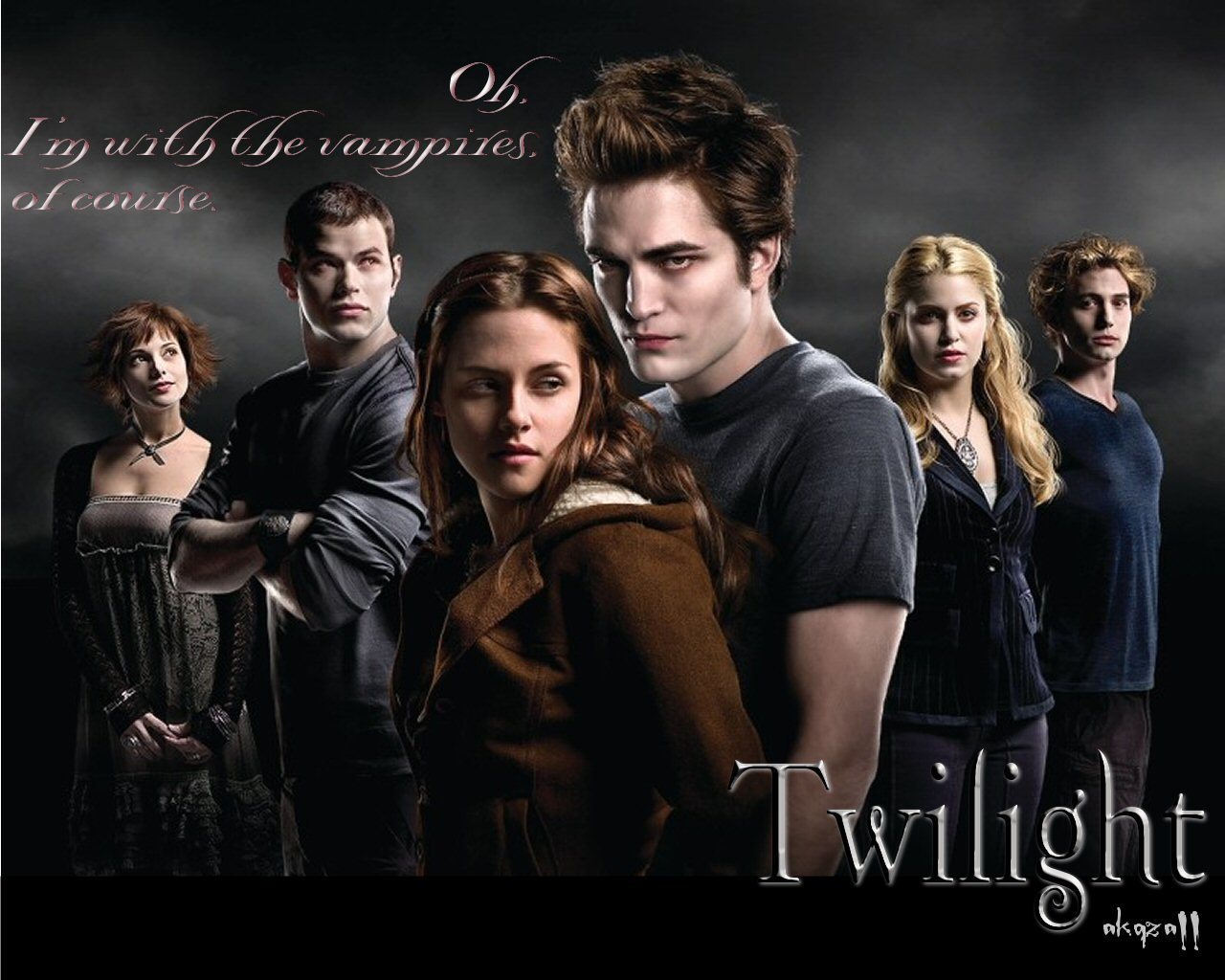 So... apparently people are all about vampires these days. If you're a second printer, you're a geek and thus have probably seen every episode of 'Buffy' and freaked out when you saw Anna Paquin naked on 'True Blood'.
I fancy myself pretty much in-the-know on geek stuff, but I totally missed the boat on this 'Twilight' business. Now, as much as I'd like to take up blog space talking about the merits of pale teenagers ogling each other and debating the merits of fluid exchange, I can't because I haven't read it nor have I seen the movie. But what I can do is ask: Where'd this recent vampire zeitgeist come from?
There's always been a steady stream of vampire-related material in pop culture. From 'Buffy' to 'Underworld' to '30 Days of Night', vampires have always tended towards ubiquity. But it seems to be in high gear at the moment. And I have a theory about why.
Vampires, in my estimation, are the recession-era undead. In times of economic uncertainty, vampires make good characters. They represent biological and economic elitism (ever notice how vampires are always loaded? I gotta get on that gravy train). And they choose who they bring into their fold. Everyone else is just food. Vampires are the ultimate 'other'... which makes sense considering that much of their mythology is probably rooted in peoples' attempts to assign logic to people or phenomena they couldn't understand. The vampire, in many popular formats, is often portrayed as an aristocrat who literally feasts on the working class. Since a lot of us have mortgages, 401(k) plans, and debts of all kinds, I don't have to explain the modern relevance of that metaphor.
A few years ago, it wasn't vampires everywhere... it was zombies. 'Dawn of the Dead', 'Land of the Dead', 'Shaun of the Dead' and '28 Days Later'* all came out around within a few years of eachother. We were all about zombies back then. And I have a theory about that too... I think zombies were appropriated as the post-9/11 undead.
Zombies represent the existential horror of terrorism. They are a nihilistic, undeterrable threat whose logical end is the destruction of society, and that is the perception (and in some cases the reality) of the modern terrorist. Zombies, like suicide bombers, are a foe beyond reason, which is why so many zombies films, either consciously or sub-consciously, seize upon our fear of the unreasonable.

I realize that these theories can't be applied uniformly, nor have I subjected them to any sort of academic rigor beyond movies that I've seen. But I'm a blogger, so I'll do as I damn well please. I do, however, believe that as consumers of pop-culture (in some cases, rabid consumers) we should do our best to put what consume in context to figure out what it says about us as a society.
Now it's your turn, fellow geeks. What other monsters or foes have a socially or politically charged significance?
* I've had a lot of arguments about whether '28 Days Later' is a zombie movie. While they are not strictly 'undead', they do have zombie-like characteristics, particularly the ones relevant to this blog post. Any application of the 'walks like a duck, talks like a duck, must be a duck' standard puts '28 Days Later' in the zombie genre. So, suck it Ben Hatton.
Wednesday, November 19, 2008
About My Hero
I remember the news a couple years back. I mean it was not one of those “I was here when…” moments but I remember my reaction. I read the Newsarama article and was like, “This is bad news.” Was it the announcement of “Batman R.I.P?” No. Was it the fact that Captain Marvel was coming back? Nope. It was when Greg Rucka decided not to renew his exclusive contract with DC. In some ways it was a sign of things to come. Here was a fantastic creator who was beginning to cut ties with the company over creative differences. Now, Devon and Graig have done a good job this week in regards to talking about DC’s choices so I do not want to talk about the second half of the sentence. Instead, I want to talk about the first half – I want to talk about Greg Rucka the fantastic creator.
 There are a lot of people out there who say that Greg Rucka is only really good at the procedural comics, the stories that revolve around ensemble casts doing the day-to-day tasks of being a hero. To those people I say bullshit. Not that Rucka is not really good at the procedural stories because he definitely is. While he was writing them Gotham Central and Checkmate were must reads for me and Devon turned me onto Queen & Country, which is simply a great nitty-gritty spy book. No, the reason I call bullshit is there are people who think Rucka is only really good at procedural comics. That is simply not true.
See the thing that makes me pick up anything with Rucka’s name on it is that he gets what is great about comics. He understands that sometimes the good guys have to lose and that sometimes you need those off moments, those down beats. He understands when to have those Bill Pullman “This is our Independence Day” type speeches and when to let Michael Holt and Sasha Bordeaux simply fall in love. He understands when to add to the mythos of a character and when to shake a character to its core. After all let us not forget that it was Rucka who penned the neck-snap-heard-round-the-world when Maxwell Lord met his end at the hands of Wonder Woman. Some people call this slow writing, I call it good a well-paced story. It is one of those potato/potato things. Which is not an example that works unless you can hear the pronunciation.
Basically what makes Rucka such an excellent comic writer is that he is a writer first and a comic writer second. Too often it feels like some writers go into writing comics because they are not good enough with a pen to draw comics. So their stories are less about plot and intrigue and mood and more about muscles and falling buildings and giant tits. They leave the planning to editors and their scripts are really about who swings an ax or who shoots a pistol. Rucka applies an author’s craft to comics and yet he understands that sequential art is a unique form of storytelling. You never get Tad Williams’ style panel exposition in his comics. As a result there is something sophisticated in his work, something that other writers do not quite do or do as well. Yes, I did use the word sophisticated in reference to a man who wrote Ultimate Elektra and Daredevil.
 So I suppose you are wondering why am I on this Greg Rucka love fest? Why did I take the time out of my grading (sophomore papers are keeping me from writing more posts) just so I could get my swoon on? It is because Rucka wrote the last two mainstream comics that reminded me of why I collect monthlies. I am not about to spoil Final Crisis: Revelations or Final Crisis: Resist because that is not my way, but simply they have been blowing me away. Rarely as a seasoned comic reader does something surprise me, does something make me stop and pull a Data at the end of Star Trek: Generations (I know, sweet nerd reference), does something make me throw my hands in the air and say, “Hell yeah!” If a writer can consistently do that – I think he deserves a moment of pure adoration.
Now, I think Grant Morrison is a fine writer who has told some fine stories, same thing with Brian Michael Bendis, but the writer I would really like to see get carte blanche with a major comic universe is Greg Rucka.
 There are a lot of people out there who say that Greg Rucka is only really good at the procedural comics, the stories that revolve around ensemble casts doing the day-to-day tasks of being a hero. To those people I say bullshit. Not that Rucka is not really good at the procedural stories because he definitely is. While he was writing them Gotham Central and Checkmate were must reads for me and Devon turned me onto Queen & Country, which is simply a great nitty-gritty spy book. No, the reason I call bullshit is there are people who think Rucka is only really good at procedural comics. That is simply not true.
See the thing that makes me pick up anything with Rucka’s name on it is that he gets what is great about comics. He understands that sometimes the good guys have to lose and that sometimes you need those off moments, those down beats. He understands when to have those Bill Pullman “This is our Independence Day” type speeches and when to let Michael Holt and Sasha Bordeaux simply fall in love. He understands when to add to the mythos of a character and when to shake a character to its core. After all let us not forget that it was Rucka who penned the neck-snap-heard-round-the-world when Maxwell Lord met his end at the hands of Wonder Woman. Some people call this slow writing, I call it good a well-paced story. It is one of those potato/potato things. Which is not an example that works unless you can hear the pronunciation.
Basically what makes Rucka such an excellent comic writer is that he is a writer first and a comic writer second. Too often it feels like some writers go into writing comics because they are not good enough with a pen to draw comics. So their stories are less about plot and intrigue and mood and more about muscles and falling buildings and giant tits. They leave the planning to editors and their scripts are really about who swings an ax or who shoots a pistol. Rucka applies an author’s craft to comics and yet he understands that sequential art is a unique form of storytelling. You never get Tad Williams’ style panel exposition in his comics. As a result there is something sophisticated in his work, something that other writers do not quite do or do as well. Yes, I did use the word sophisticated in reference to a man who wrote Ultimate Elektra and Daredevil.
 So I suppose you are wondering why am I on this Greg Rucka love fest? Why did I take the time out of my grading (sophomore papers are keeping me from writing more posts) just so I could get my swoon on? It is because Rucka wrote the last two mainstream comics that reminded me of why I collect monthlies. I am not about to spoil Final Crisis: Revelations or Final Crisis: Resist because that is not my way, but simply they have been blowing me away. Rarely as a seasoned comic reader does something surprise me, does something make me stop and pull a Data at the end of Star Trek: Generations (I know, sweet nerd reference), does something make me throw my hands in the air and say, “Hell yeah!” If a writer can consistently do that – I think he deserves a moment of pure adoration.
Now, I think Grant Morrison is a fine writer who has told some fine stories, same thing with Brian Michael Bendis, but the writer I would really like to see get carte blanche with a major comic universe is Greg Rucka.
Internet Killed The Comic Book Story
It's doom and gloom week here at Second Printing, and while I would like to turn the tide and uplift our readers (and ourselves), instead I'm going to sally forth and add my two dollars and twenty-two cents worth of grousing to the pot(man, inflation is a real bitch).
 I just came over from reading this week's Lying in the Gutters where the rumour is Dan DiDio is on a Darkseid-esque bender, vying for total control of the DC Universe. Final Crisis is looking to be further delayed and potentially out of Morrison's hands (and Morrison potentially washing his hands of DC), the DC Universe that is supposed to result at the end of FC is also on hold until the Crisis finale is finalized, and James Robinson's triumphant return to DC looks to be short-lived as well following a blow-out with DiDio. No word on what Morrison and Robinson's co-conspirator Geoff Johns is going to do, but all bets are the non-UK-import amongst them is going to keep his head down and keep cashing paycheques.
 Now, this is all unsubstantiated, unconfirmed by any of the parties involved (today at least) but it's enough to annoy me. Given the time and money I've invested into things like Final Crisis (not to mention the "five-year plan" that started back with Identity Crisis), knowing that the creator's vision will be disrupted and therefore compromising the entire intent of the series, doesn't sit very well. These editorial interferences, Chuck Dixon's runs on Robin and Batman and the Outsiders another example from earlier this year, is frustrating as a fan.
It's a fact of the business that the creators aren't ultimately in control of their work. They're dealing with proprietary characters, and business concerns (which fall under editorial/DiDio's domain) are the overriding principle. DiDio's prime concerns seem to be, somewhat confusingly, the DCU continuity... where it's been and where it's going. Change isn't in the air under DiDio's reign, reminiscence and restoration seems to be more flavour of the day (erm, decade). Continuity is a story killer as much as it's a story enhancer. Final Crisis started by having to relate itself, however briefly, to Countdown and Death of the New Gods. It's legendary how poorly the three series intersected with one another (in that they really didn't), and now the finale of Final Crisis is supposed to lead the way to a brand new DCU... just not the way Morrison originally designed.
Now I don't know much about Countdown or DOTNG, but I have to wonder if they were failures because of editorial interference or for lack of (or were they just ill-conceived and capitalistic from the start?). In my opinion, editorial interference, like studio interference with movies, rarely leads to a better end product. I'd rather read a Final Crisis that was solely Morrison's vision and then the DCU ignore it altogether afterward (wouldn't be the first time) than have a watered down or compromised version of the story. Either way, you're getting a continuity that doesn't ultimately make sense and years later is still being explained At least in the former instance there's some artistic integrity involved. I'm starting to think that maybe Kirkman's right... but that's me.
Out of all of this, I see two big problems with mainstream comics readers (not comics, themselves) today. The first is we're too informed. We have unprecedented access to creators and publishers, editors and distributors, to the point where we know pretty much what's going to happen before it happens. With Previews giving us a 2 to 3 month look ahead, we're always on top of things. DiDio and Quesada and nearly every other publisher gets out there and shills to us, the regular reader, vying for our money by tantalizing us with big announcements and getting us excited by hypothetical situations. When the announcements or stories don't pan out as we've been told we're doubtlessly disappointed, until we get the apology and the new shill. "Yes, we fucked that up, but wait 'til you see what happens next..." That can only go on for so long before we're all exhausted by it.
We have daily access to information and interviews, we get teasers and teases from all around, but when nearly every comic is hyped to the point where it can't really live up to all the talk that surrounds it, where does that leave the reader? Back in the day, these decisions happened behind closed doors, and most of the readers would see the stories unfold, free of the behind-the-scenes drama and the non-stop pitches. Welcome to the internet age, the information age, where it's all-access all the time. Creators and publishers want people to read their books, so they're not going to stop schilling them, but if you find your level of enjoyment doesn't live up to your initial excitement (or hell, if you're failing to get excited about anything at all), perhaps you need to step away from the internet, from the great white noise hype machine, and go back to just discovering things at random off the stands or through recommendations. Read what you enjoy, not what's been sold to you. Is it possible? I don't know.
Point number two finds another, if lesser problem with today's mainstream comic readers... we're "have your cake and eat it too" kind of people. We want our mainstream comic creators to have their voice, but we also want them to have the unified voice of their shared universe, and I don't think the two work well together. So I guess we need to ask, are we willing to sacrifice one for the other. Which would you prefer, tighter continuity or more creator-driven stories?
I'll be back next week with bright lights, and things that make me cheerful about comic books and being a comic book fan. Like a "thanksgiving" themed post-kinda thing.
 I just came over from reading this week's Lying in the Gutters where the rumour is Dan DiDio is on a Darkseid-esque bender, vying for total control of the DC Universe. Final Crisis is looking to be further delayed and potentially out of Morrison's hands (and Morrison potentially washing his hands of DC), the DC Universe that is supposed to result at the end of FC is also on hold until the Crisis finale is finalized, and James Robinson's triumphant return to DC looks to be short-lived as well following a blow-out with DiDio. No word on what Morrison and Robinson's co-conspirator Geoff Johns is going to do, but all bets are the non-UK-import amongst them is going to keep his head down and keep cashing paycheques.
 Now, this is all unsubstantiated, unconfirmed by any of the parties involved (today at least) but it's enough to annoy me. Given the time and money I've invested into things like Final Crisis (not to mention the "five-year plan" that started back with Identity Crisis), knowing that the creator's vision will be disrupted and therefore compromising the entire intent of the series, doesn't sit very well. These editorial interferences, Chuck Dixon's runs on Robin and Batman and the Outsiders another example from earlier this year, is frustrating as a fan.
 It's a fact of the business that the creators aren't ultimately in control of their work. They're dealing with proprietary characters, and business concerns (which fall under editorial/DiDio's domain) are the overriding principle. DiDio's prime concerns seem to be, somewhat confusingly, the DCU continuity... where it's been and where it's going. Change isn't in the air under DiDio's reign, reminiscence and restoration seems to be more flavour of the day (erm, decade). Continuity is a story killer as much as it's a story enhancer. Final Crisis started by having to relate itself, however briefly, to Countdown and Death of the New Gods. It's legendary how poorly the three series intersected with one another (in that they really didn't), and now the finale of Final Crisis is supposed to lead the way to a brand new DCU... just not the way Morrison originally designed.
Now I don't know much about Countdown or DOTNG, but I have to wonder if they were failures because of editorial interference or for lack of (or were they just ill-conceived and capitalistic from the start?). In my opinion, editorial interference, like studio interference with movies, rarely leads to a better end product. I'd rather read a Final Crisis that was solely Morrison's vision and then the DCU ignore it altogether afterward (wouldn't be the first time) than have a watered down or compromised version of the story. Either way, you're getting a continuity that doesn't ultimately make sense and years later is still being explained At least in the former instance there's some artistic integrity involved. I'm starting to think that maybe Kirkman's right... but that's me.
Out of all of this, I see two big problems with mainstream comics readers (not comics, themselves) today. The first is we're too informed. We have unprecedented access to creators and publishers, editors and distributors, to the point where we know pretty much what's going to happen before it happens. With Previews giving us a 2 to 3 month look ahead, we're always on top of things. DiDio and Quesada and nearly every other publisher gets out there and shills to us, the regular reader, vying for our money by tantalizing us with big announcements and getting us excited by hypothetical situations. When the announcements or stories don't pan out as we've been told we're doubtlessly disappointed, until we get the apology and the new shill. "Yes, we fucked that up, but wait 'til you see what happens next..." That can only go on for so long before we're all exhausted by it.
We have daily access to information and interviews, we get teasers and teases from all around, but when nearly every comic is hyped to the point where it can't really live up to all the talk that surrounds it, where does that leave the reader? Back in the day, these decisions happened behind closed doors, and most of the readers would see the stories unfold, free of the behind-the-scenes drama and the non-stop pitches. Welcome to the internet age, the information age, where it's all-access all the time. Creators and publishers want people to read their books, so they're not going to stop schilling them, but if you find your level of enjoyment doesn't live up to your initial excitement (or hell, if you're failing to get excited about anything at all), perhaps you need to step away from the internet, from the great white noise hype machine, and go back to just discovering things at random off the stands or through recommendations. Read what you enjoy, not what's been sold to you. Is it possible? I don't know.
Point number two finds another, if lesser problem with today's mainstream comic readers... we're "have your cake and eat it too" kind of people. We want our mainstream comic creators to have their voice, but we also want them to have the unified voice of their shared universe, and I don't think the two work well together. So I guess we need to ask, are we willing to sacrifice one for the other. Which would you prefer, tighter continuity or more creator-driven stories?
I'll be back next week with bright lights, and things that make me cheerful about comic books and being a comic book fan. Like a "thanksgiving" themed post-kinda thing.
Tuesday, November 18, 2008
The Event Horizon Tells Me Otherwise
Lately, I don't quite know what's going on with my comics and I.
I know that I love them. I know this much is true.
 It's just that I don't treat like I used to. I still look forward to the next issue of 100 Bullets like no one's business but as I was reading the latest issue, it dawned on me...
The comics that made me a fan all over again is coming to an end.
And likely, I won't ever find anything that good ever again. Better yet, I probably won't find that book that blows my mind, makes me reconsider what the comics format can do and has me hold it up in the air like a infant Kunta Kinte anytime some asks me, "What's good?"
The fact of it is that lately I just don't look forward to my comics like I used to. I am sitting here, typing and wrestling with the realization that the belief "that a man can fly" ain't what it used to be.
Today's comics market is filled with flying men and women talking loudly and not really saying anything. What it comes down to is this:
We should not be shocked when our superhero comics are actually, you know... good.
 As I sit here typing this I realize my comics, overall, haven't been that great, much less that good, in a loooooong time. The exceptions usually a critically acclaimed and reader-shunned. For every Blue Beetle or Manhunter, there will be four more unnecessary X-titles and mini-series that will outsell it by the tens of thousands. This is and always has been the state of this industry.
It's not going to get any better any time soon. As DC Comics continually trips and stumbles towards Final Crisis, we've been promised... something. No one knows what it is, though and really, I just don't care. If it's has any of the promise of a Countdown or a Trinity, no thanks.
On the Marvel side of things, for the first time since Secret Wars II, I did not bother with their big "event" book, Secret Invasion. I'm just over events that will rock universes down to their very foundation being done once a year and over multiple $3.99 books.
As for Secret Invasion's sequel, Dark Reign?
To Marvel, again, no thanks.
I miss having something to look forward to in my comics. I am tired of being shocked when I put a comic down and thinking, "That was good." We should not be shocked when our comics are good. This should be our standard.
Individual comics storylines are continuously being dragged, kicking and screaming, into the "event" and the spirit of "the good comic" is the unintended victim.
In all of this, my good will is spent. Squandered by the companies I counted on to entertain me. I want no more crossovers. I don't feel like going on any more journeys with you. I should not have to work so hard to enjoy my comics. I simply want more good in my comics and I'm just not getting it like I used to.
I want comics I can recommend. I wish there were more coming. The event horizon tells me otherwise.
I know that I love them. I know this much is true.
 It's just that I don't treat like I used to. I still look forward to the next issue of 100 Bullets like no one's business but as I was reading the latest issue, it dawned on me...
The comics that made me a fan all over again is coming to an end.
And likely, I won't ever find anything that good ever again. Better yet, I probably won't find that book that blows my mind, makes me reconsider what the comics format can do and has me hold it up in the air like a infant Kunta Kinte anytime some asks me, "What's good?"
The fact of it is that lately I just don't look forward to my comics like I used to. I am sitting here, typing and wrestling with the realization that the belief "that a man can fly" ain't what it used to be.
Today's comics market is filled with flying men and women talking loudly and not really saying anything. What it comes down to is this:
We should not be shocked when our superhero comics are actually, you know... good.
 As I sit here typing this I realize my comics, overall, haven't been that great, much less that good, in a loooooong time. The exceptions usually a critically acclaimed and reader-shunned. For every Blue Beetle or Manhunter, there will be four more unnecessary X-titles and mini-series that will outsell it by the tens of thousands. This is and always has been the state of this industry.
It's not going to get any better any time soon. As DC Comics continually trips and stumbles towards Final Crisis, we've been promised... something. No one knows what it is, though and really, I just don't care. If it's has any of the promise of a Countdown or a Trinity, no thanks.
On the Marvel side of things, for the first time since Secret Wars II, I did not bother with their big "event" book, Secret Invasion. I'm just over events that will rock universes down to their very foundation being done once a year and over multiple $3.99 books.
As for Secret Invasion's sequel, Dark Reign?
To Marvel, again, no thanks.
I miss having something to look forward to in my comics. I am tired of being shocked when I put a comic down and thinking, "That was good." We should not be shocked when our comics are good. This should be our standard.
Individual comics storylines are continuously being dragged, kicking and screaming, into the "event" and the spirit of "the good comic" is the unintended victim.
In all of this, my good will is spent. Squandered by the companies I counted on to entertain me. I want no more crossovers. I don't feel like going on any more journeys with you. I should not have to work so hard to enjoy my comics. I simply want more good in my comics and I'm just not getting it like I used to.
I want comics I can recommend. I wish there were more coming. The event horizon tells me otherwise.
Subscribe to:
Posts (Atom)